
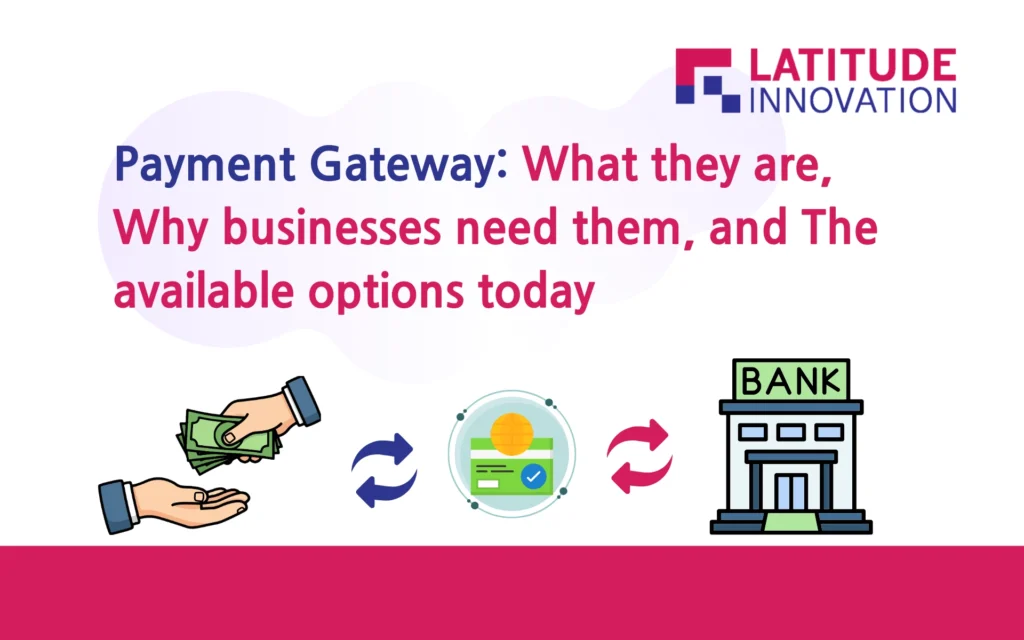
Payment Gateway: What they are, why businesses need them, and the available options today
1.0 What Is a Payment Gateway?
A payment gateway is a technology platform that securely processes online transactions between a customer and a business. It acts as the “bridge” that transfers payment information from your website or app to the bank or payment provider, and then returns approval or decline messages.
Most businesses use a third-party payment gateway instead of building their own because processing payments is highly complex and heavily regulated. Developing your own system requires meeting strict security standards like PCI-DSS, handling encryption, fraud detection, and secure data storage, as well as creating direct connections to banks and card networks—which most businesses cannot access on their own. Building all of this in-house is expensive, time-consuming, and risky. A third-party gateway provides all the required security, compliance, and bank integrations out of the box, making it a much safer, faster, and more affordable option for businesses.
Customers expect quick, safe, and easy ways to make payments in today’s digital economy, whether they are using mobile apps or online shopping. Payment gateways are essential in this situation
2.0 Why should Businesses use a Payment Gateway?
There are several reasons why implementing a payment gateway is vital in modern business. Here are six reasons:
1. Secure Transactions
Payment gateways follow strict security standards (e.g., PCI-DSS compliance) to ensure customer data is protected. This builds trust and reduces fraud risks.
2. Accept Multiple Payment Methods
Modern customers expect flexibility. A payment gateway lets businesses accept:
- Credit & debit cards
- FPX online banking
- E-wallets (Touch ‘n Go eWallet, GrabPay, Boost, etc.)
- Buy Now Pay Later options (Atome, SPayLater)
- QR-based payments (DuitNow)
3. Faster Payments & Better Cash Flow
Payments are processed instantly, and settlements are credited to your bank account quickly usually within 1 to 3 working days.
4. Improved Customer Experience
A smooth checkout increases conversion rates. A complex or slow payment system can cause customers to abandon the cart.
5. Automated Reporting & Tracking
Most gateways include dashboards to track sales, monitor transactions, and manage payouts, reducing manual work.
6. Scalable for Small to Large Businesses
Whether you’re selling products, digital services, or running subscription-based services, a payment gateway grows with your needs
3.0 Payment Gateway Services
A payment gateway typically provides:
- Online Checkout Services
Integratable with websites or mobile apps via API, plugins, or hosted payment pages. - Subscription & Recurring Payments
Useful for memberships, SaaS platforms, tuition centres, and digital services. - Invoicing & Payment Links
Businesses can send customers a link to pay instantly—no website needed. - Fraud Prevention Tools
Includes risk scoring, 3D Secure authentication, and monitoring to protect users. - Multi-currency Support
Some gateways support international payments and foreign currency settlement.
4.0 Types of Payment Gateways
Payment gateways come in several forms, each designed for different business models, technical needs, and customer experiences. Understanding the differences helps businesses choose the right solution for smooth, secure, and scalable payment processing.
* host payment gateway
1. Bank Payment Gateways
Bank payment gateways are provided directly by financial institutions. They typically support FPX (online banking), debit/credit card processing, and direct settlement within the same bank.
Best For:
Businesses that want direct settlement, prefer using their existing bank relationship, or need a trusted and traditional payment setup.
Features
- Direct settlement into your bank account
- Supports FPX, debit cards, and sometimes credit cards
- Higher trust from customers due to bank branding
- Stable and regulated infrastructure
Limitations
- Integration can be more complex and slower
- Approval/setup processes often take longer
- Fewer payment method options than modern fintech gateways
- Limited API flexibility compared to private payment processors
Examples:
Maybank2U Pay, CIMB ePay
2. Self-Hosted / API Payment Gateways
With this model, the entire checkout happens on your own website or app, and payments are processed via API in the background. This gives you full control over the design and user flow.
Best For:
Businesses needing a custom checkout, such as SaaS platforms, subscription businesses, or companies that want to reduce friction during payment.
Features
- Fully customizable checkout experience
- Customer never leaves your site (higher conversion)
- Supports advanced features like subscriptions, tokenization, recurring billing
- Can integrate with mobile apps and custom software
- Strong API documentation and developer tools
Limitations
- Requires technical knowledge or developer support
- PCI-DSS compliance may apply if handling sensitive data incorrectly
- Setup and maintenance may be more costly compared to simple hosted pages
Examples:
Stripe, Razer Merchant Services API, iPay88 API
3. Hosted Payment Gateways
Customers are redirected to a secure external page to complete payment. After completing, they are redirected back to your site.
Best For:
Businesses that want simple, fast integration with minimal security or compliance responsibility.
Features
- Quick setup & easy integration (copy-paste IPN/URL)
- Gateway handles all security, encryption, and PCI compliance
- Good for small businesses or beginner e-commerce sellers
- Supports FPX, cards, e-wallets depending on provider
Limitations
- Customer leaves your site → lower conversion compared to on-site payment
- Limited ability to customize the payment page design
- Less control over the user experience
Examples:
Billplz, SenangPay, iPay88 Hosted Page
4. All-in-One Payment Platforms
These platforms offer multiple payment tools in a single ecosystem — online payments, POS systems, QR Pay, invoicing, payment links, and more.
Best For:
Small businesses, retail stores, and merchants who accept both online + offline payments.
Features
- Online payment gateway + offline POS
- QR Pay (DuitNow, GrabPay, ShopeePay depending on provider)
- Invoicing, recurring billing, and payment links
- Inventory tracking or basic business analytics
- Ideal for F&B, retail, gyms, tuition centers
Limitations
- Usually fewer advanced API options compared to specialized gateways
- May be more expensive due to additional hardware or subscription fees
- Some platforms have limited scalability for enterprise use
Examples:
HitPay, Shopify Payments (global), Square (global)
5. White-Label Payment Gateways
A business uses an existing gateway’s infrastructure but brands it as their own, offering a seamless experience to users.
Best For:
Marketplaces, SaaS platforms, fintech companies, or large enterprises wanting to control the full payment journey without building a gateway from scratch.
Features
- Full branding (your logo, your domain, your UI)
- Custom payment flows for platforms and marketplaces
- Supports multi-vendor payouts, split payments, wallets
- Ability to build a fully branded payment infrastructure
Limitations
- Requires technical expertise to integrate
- Higher setup cost and possible monthly licensing fees
- More suitable for mid-to-large businesses rather than small merchants
Examples:
Custom fintech platforms, SaaS platforms using white-label APIs (e.g., through Stripe Connect or Adyen for global markets
5.0 Popular Payment Gateway Options in Malaysia
Malaysia has a strong fintech landscape, offering many competitive payment gateways. Here are the most widely used ones:
1. iPay88 (NTT-DATA)
Description: One of Malaysia’s oldest and most trusted payment gateways, widely used by local e-commerce businesses and marketplaces. It supports credit/debit cards, FPX online banking, and local e-wallets
Key Features: Multi-channel payment support, PCI-DSS compliance, integration with major platforms like WooCommerce and Shopify.
Who Uses It: E-commerce stores, SMEs, retail merchants focusing on Malaysian customer base.
Sandbox Available: Yes – offers developer test environments for integration testing (most established gateways like iPay88 provide this, though specifics are through developer docs).
2. Razorpay (Curlec)
Description: A newer Malaysian payment gateway focused on providing simple, SME-friendly payment solutions. It supports major local payment methods including FPX, credit/debit cards, and popular e-wallets. Known for fast onboarding and straightforward pricing, making it attractive for small to mid-sized businesses.
Key Features: Supports FPX, cards, and major e-wallets, Simple integration for websites and mobile apps, Quick merchant onboarding, Basic dashboard with transaction insights, Recurring payments and subscription support (depending on plan)
Who Uses It: SMEs, micro-businesses, startups, and service-based businesses looking for an easy and affordable gateway.
Sandbox Available: Yes – provides a testing environment for developers (details depend on their developer documentation).
3. KiplePay
Description: KiplePay is a Malaysian fintech solution under Axiata, offering payments for both consumers and merchants. It supports online payments, QR payments, and campus/enterprise wallet ecosystems. Known for its adoption within universities and institutions.
Key Features: Supports FPX, credit/debit cards, and Kiple e-wallet, QR payment support (DuitNow QR compatible in many setups), Strong in closed-loop environments (campus, corporate, communities), Merchant dashboard for settlements, reports, and reconciliation, Integration tools for e-commerce and mobile apps
Who Uses It: Businesses serving younger demographics (students), SMEs using QR-based transactions, institutions (universities), and enterprises wanting wallet-based ecosystems.
Sandbox Available: Yes – sandbox/testing environment available for integrations (usually provided through API documentation).
4. Fiuu (formerly Razer Merchant Services) (formerly MOLPay)
Description: A strong e-commerce payment provider with broad local payment options and fraud tools.
Key Features: FPX, e-wallets (Boost, GrabPay, etc.), installment options, integration with major CMS platforms.
Who Uses It: Medium-to-large online stores, gaming and retail platforms with higher transaction volumes.
Sandbox Available: Yes – sandbox/testing environments supported for integration.
5. Billplz
Description: Simple and affordable payment gateway popular with small businesses and non-profits.
Key Features: FPX transfers, local e-wallets, invoicing tools, subscription billing.
Who Uses It: Small businesses, service providers, NGOs, freelancers.
Sandbox Available: Yes – typically offers a test mode for API and integration testing.
6. SenangPay
Description: User-friendly gateway focused on fast setup and easy business onboarding.
Key Features: FPX, credit/debit cards, basic fraud features, quick integration.
Who Uses It: Small and medium businesses, especially those on WordPress, WooCommerce, and Shopify.
Sandbox Available: Yes – includes test credentials for development
6.0 Top 3 Most Used International Payment Gateways
1. PayPal
Description: Globally recognized payment platform that supports online payments, wallets, and international transactions.
Key Features: Multi-currency support, buyer/seller protection, express checkout, global reach.
Who Uses It: Businesses selling internationally, marketplaces, small e-commerce sites.
Sandbox Available: Yes – robust sandbox environment for testing without real transactions.
2. Stripe
Description: Developer-friendly gateway popular for custom integrations, subscriptions, and marketplaces.
Key Features: Advanced APIs, subscriptions, multi-currency support, fraud tools.
Who Uses It: Startups, SaaS platforms, tech-driven e-commerce, large online businesses.
Sandbox Available: Yes – offers isolated sandbox for testing payment flows.
3. 2C2P
Description: Enterprise-grade global payment gateway focused on Southeast Asia and beyond, supporting a wide range of cards, digital wallets, QR and local payment methods with unified processing.
Key Features: Omnichannel acceptance across online/mobile/offline, multi-currency support, broad local & international payment methods, tokenisation & recurring billing, strong security/compliance.
Who Uses It: Airlines, large e-commerce platforms, travel companies and international retailers.
Sandbox Available: Yes – provides sandbox/test environments for developers
7.0 What Is a Sandbox Environment
A sandbox is a safe testing environment provided by a payment gateway that allows developers and businesses to simulate real transactions without using actual money. It behaves exactly like the real (live) payment system, but all payments are fake and risk-free.
Payment gateways provide sandbox accounts so you can:
- Test your checkout flow
- Try API integrations
- Simulate successful and failed transactions
- Ensure everything works before going live
- Avoid charging real cards or affecting real bank accounts
8.0 Conclusion
A reliable payment gateway is crucial for any modern business looking to grow in Malaysia’s fast-expanding digital economy. The right solution doesn’t just process payments; it helps you increase sales, minimise downtime, and deliver a seamless, trustworthy customer experience.
If you’re exploring which payment gateway to use for your online store, service business, or subscription platform, Curlec is an excellent choice. It offers strong reliability, competitive pricing, and powerful features tailored for Malaysian businesses.
To get started easily, you can sign up through my referral link below:
WhatsApp Us: https://wa.me/60104348799/
Our Services: https://latitudeinnovation.com.my/web-design-service
Choosing the right gateway today can set the foundation for your business growth tomorrow and Curlec is a strong partner to help you get there.